
Analog Circuits

Lesson 1.10: Superposition
If you remember from all our previous lessons so far, there wasn't a single variable with an exponent greater than 1. That's because the circuit's we've been working with are all linear. Because they're linear, we can use a cheat code to solve them: superposition. Superposition says that if you have multiple inputs and just one output, you can consider what the output would look like with each input separately, then add up all the results. Mathematically, if you have inputs \( x_1 \) and \( x_2 \), and your output function is some function \( f, \) superposition says that \[ f(x_1 + x_2) = f(x_1) + f(x_2) \] and \[ f (\alpha x) = \alpha f(x). \]
And that's all there is to it. It's easier to understand how this idea applies to circuit analysis through an example. In all cases, we say the sources (voltage or current) are the inputs.
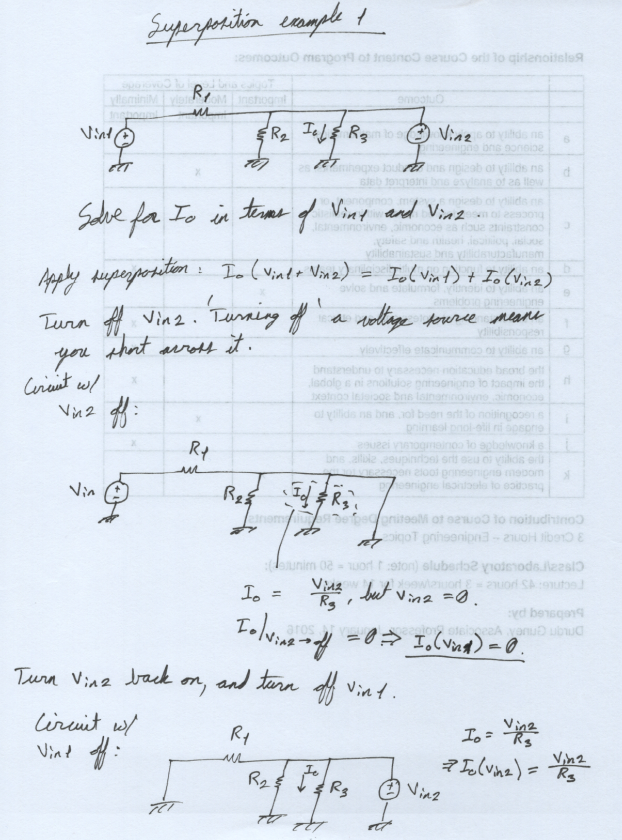
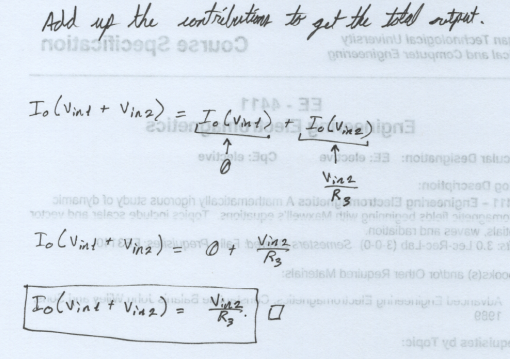
Bottom line. For linear systems and equations, superposition says that \( f(x_1 + x_2 + ... + x_n) = f(x_1) + f(x_2) + ... + f(x_n) \) and \( f(\alpha_1 \alpha_2 ... \alpha_n x) = ( \alpha_1 \alpha_2 ... \alpha_n ) f(x) \). Turning off a voltage source means replacing it with a short circuit so that its voltage \( V = 0 \). Turning off a current source means replacing it with an open circuit so that its current \( I = 0 \).
If you found this content helpful, it would mean a lot to me if you would support me on Patreon. Help keep this content ad-free, get access to my Discord server, exclusive content, and receive my personal thanks for as little as $2. :)
Become a Patron!